

When is implant placement necessary?
Dental implants are an ideal solution for patients who have lost one or more teeth due to: cavities or gum disease, tooth injury and trauma, periodontal disease, long-term wearing of ill-fitting dentures.
Implants not only restore the functionality of the jaw, but also prevent further bone decay, which often happens when the entire tooth or tooth root is missing.
What does the process look like?
The installation of dental implants consists of several precisely planned steps:
-
First consultation and planning
Our experts analyze the condition of your teeth, gums, and jaw using state-of-the-art diagnostic equipment, including digital orthopantograms and 3D scanners. Based on these, we create an individual treatment plan. -
Installation of implants
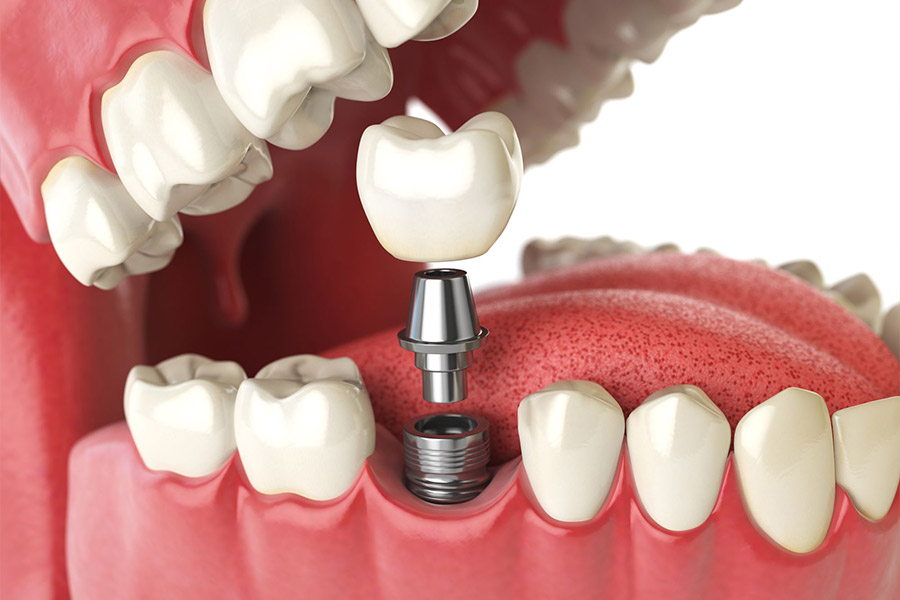
The implant, made of high-quality titanium, is surgically placed into the jawbone. This procedure is painless thanks to local anesthesia and a minimally invasive technique. -
Fusion period (osseointegration)
After placement, the implant fuses with the bone over a period of several months, providing a solid foundation for a future crown or bridge. -
Placing the prosthetic part
After completed osseointegration, a metal-ceramic or zirconium crown is placed on the implant, which is completely adapted to the color and shape of your natural teeth.
We represent several implant systems with great success
All implant systems are of exceptional quality. The decision to set up is determined depending on the indication. Our broad experience has shown certain advantages of certain systems according to the position and structure of the bone.
- Astra Tech ® (Sweden, USA)
- Zimmer ® (USA)
- AlphaBio ® (Israel)
- ICX ® (Germany, Switzerland)